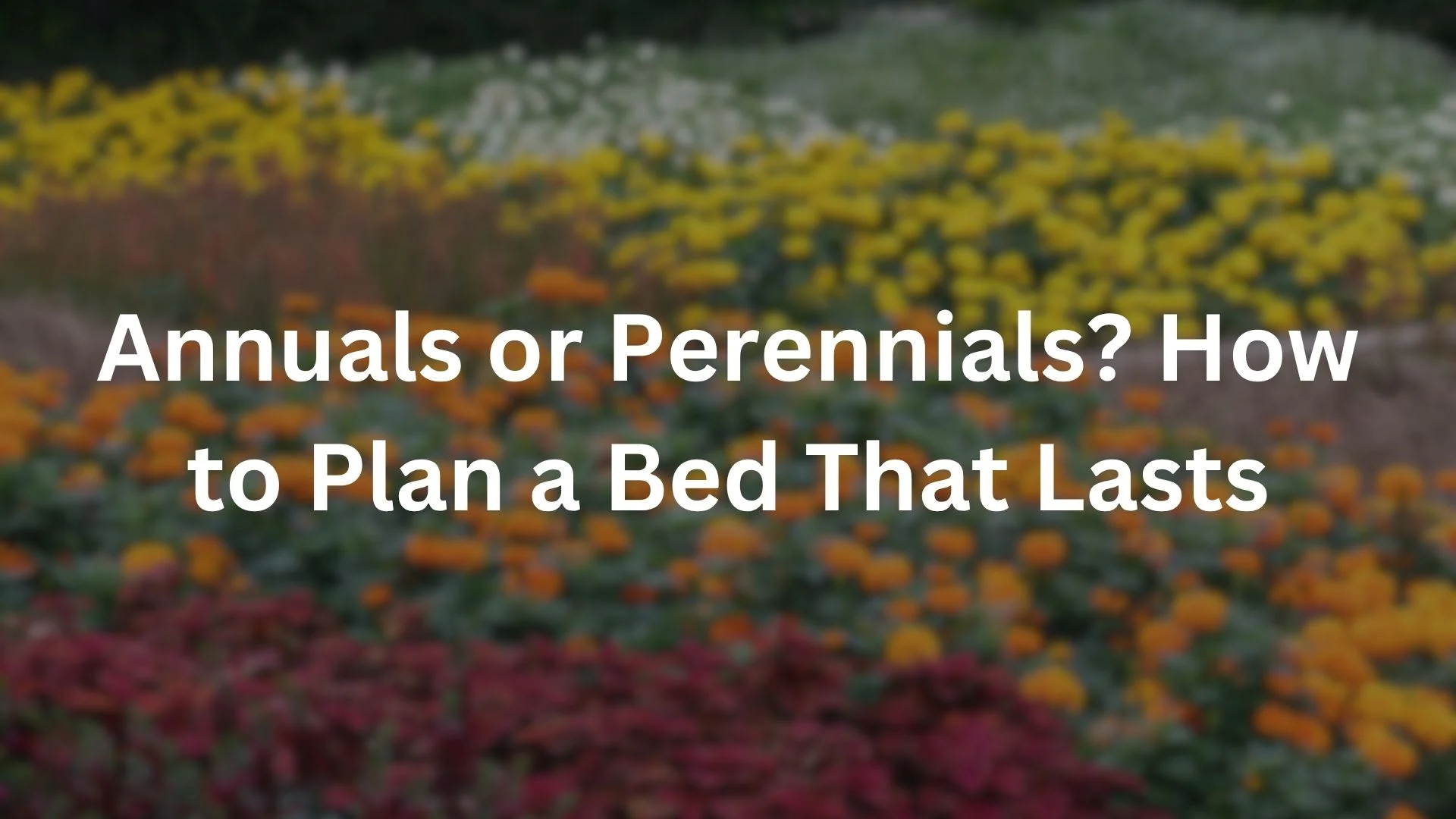
Someone plants up a new bed in May with trays of bedding. It looks magnificent through summer. By October it is going over, by November it is bare soil, and from then until the following May there is nothing to look at from the kitchen window.
That is six months of the year looking at nothing, in a country where the garden is mostly something you view from indoors. And then it all has to be bought and planted again.
If you’re planning a project of your own, see how we handle garden design and landscaping in Glasgow, from first idea to final planting.
The fix is not complicated. It is a question of what goes in the bed and in what proportion. This guide explains the difference between annuals and perennials, what each actually costs over five years, and how to plan a bed that holds up in January as well as July. We work across Glasgow and the Central Belt, so every plant named has been chosen for Scottish conditions.
The difference in plain terms
Annuals complete their entire life cycle in one growing season. They germinate, grow, flower, set seed and die, all within a year. Next spring you buy them again.
Perennials live for several years. Herbaceous perennials die back to the ground over winter and regrow from the same roots each spring. They get bigger and better for the first few years.
Biennials sit between the two. They grow leaves in year one, flower and set seed in year two, then die. Many self seed freely, so they keep appearing without you doing anything. Foxglove, honesty and wallflower are the common ones, and foxglove in particular is excellent here.
| Annuals | Perennials | |
| Lifespan | One season | Several years to decades |
| Replanting | Every year, often twice | Once |
| Flowering season | Long, continuous | Shorter, species specific |
| Winter presence | None | Structure, or dormant crowns |
| Year one impact | Immediate, full | Modest |
| Year three impact | Same as year one | Considerably better |
| Cost per plant | Low | Higher |
| Cost over five years | High | Low |
| Work involved | High, replanting twice yearly | Low, one cut back a year |
| Can be divided | No | Yes, free plants |
Why an all annual bed fails in Scotland
The problem is seasonal, and it is worse here than further south.
Our season is short. Late springs and early autumn frosts mean bedding plants have a narrower window. Summer bedding cannot safely go out until risk of frost has passed, often late May in the Central Belt, and it is finished by October. That is roughly five months of performance from a twelve month bed.
We look at gardens from indoors. Dark evenings and wet weather mean a great deal of Scottish garden viewing happens through a window. A bed that is bare soil from November to May is bare soil during exactly the period you are looking at it most.
Winter structure matters more here. In a longer, milder growing season a bare bed matters less because the gap is shorter. Our gap is half the year.
The result: a bed of annuals is a summer display, not a garden. It can be a wonderful summer display, but it needs something underneath it that is present the rest of the time.
What each actually costs
The per plant price makes annuals look cheap. Over five years the picture reverses completely.
A worked comparison, 10m² bed
Illustrative, using typical garden centre pricing. Figures move with supplier, plant size and season.
All annuals, replanted twice a year
| Year | Spring bedding | Summer bedding | Compost | Annual total |
| 1 | £45 | £60 | £20 | £125 |
| 2 | £45 | £60 | £20 | £125 |
| 3 | £45 | £60 | £20 | £125 |
| 4 | £45 | £60 | £20 | £125 |
| 5 | £45 | £60 | £20 | £125 |
| Five year total | £625 |
Perennials with a few annuals for gaps
| Year | Perennials | Annuals for gaps | Mulch | Annual total |
| 1 | £280 | £25 | £15 | £320 |
| 2 | £0 | £20 | £15 | £35 |
| 3 | £0 | £15 | £15 | £30 |
| 4 | £0 | £0 | £15 | £15 |
| 5 | £0 | £0 | £15 | £15 |
| Five year total | £415 |
The perennial bed costs more in year one and considerably less overall. It also looks better every year rather than the same every year, and by year three the perennials have filled out enough that the annual gap filling stops being necessary.
The time cost, which is bigger
| Annuals | Perennials | |
| Clearing and replanting | Twice a year | Never |
| Watering | Frequent, shallow rooted | First year only |
| Deadheading | Regular, to keep flowering | Occasional |
| Cutting back | Not applicable | Once, late winter |
| Dividing | Not applicable | Every few years, and it gives you free plants |
For a 10m² bed, annuals mean perhaps two full days a year of clearing, buying and replanting. Perennials mean one afternoon in late winter. Over five years the difference is substantial.
The hidden bonus
Perennials can be divided. After three or four years most clumps can be lifted and split into several plants. A bed planted once can supply the plants for a second bed later, at no cost. Nothing comparable happens with annuals.
The planning principle: layers
Think of a bed as four layers, each doing a different job.
| Layer | What it provides | Share of the bed |
| Shrubs and evergreens | Year round structure, winter presence | 20 to 30% |
| Herbaceous perennials | The main display, spring to autumn | 50 to 60% |
| Bulbs | Early colour before perennials wake up | Interplanted |
| Annuals | Gap filling, pots, long summer colour | 10 to 20% |
The structural layer is what an all annual bed is missing. A few evergreen shrubs mean the bed still has shape, mass and something to look at in February. Everything else can come and go around them.
The ratio in practice
Year one: perennials are small and there will be gaps. Fill them with annuals. This is exactly what annuals are good at, and it stops the bed looking sparse while things establish.
Year two: perennials have bulked up. Fewer gaps, fewer annuals.
Year three onwards: perennials have closed over. Annuals become optional, confined to pots or to a specific spot where you want a long run of colour.
The annual spend reduces every year rather than repeating. That is the whole argument.
A worked planting plan
A 10m² bed, roughly 5m long by 2m deep, facing west, clay soil, part sun with shade from a fence at the back for part of the day. The kind of bed in a great many Central Belt gardens.
The structural layer, 4 plants
| Plant | Quantity | Role |
| Dogwood, Cornus sanguinea | 2 | Winter stem colour, handles clay and wet, tough |
| Holly, compact variety | 1 | Evergreen mass at the back, winter berries |
| Hydrangea | 1 | Long summer season, performs well on clay, seed heads hold through winter |
These four carry the bed from November to April.
The perennial layer, around 20 plants
| Plant | Quantity | Season | Notes |
| Geranium macrorrhizum | 5 | May to Aug | Ground cover, thrives on clay, almost unkillable |
| Astrantia | 3 | Jun to Sep | Likes damp, part shade, long flowering |
| Hardy geranium, Rozanne type | 3 | Jun to Oct | Exceptionally long season |
| Meadowsweet | 3 | Jun to Aug | Native, scented, loves damp clay |
| Knapweed | 3 | Jul to Sep | Native, butterflies, very tough |
| Deschampsia, tufted hair grass | 3 | Jul to Feb | Native grass, movement, holds form into winter |
Planting in threes and fives rather than singly is what makes a bed read as designed. One of everything looks like a collection.
Bulbs, interplanted
| Bulb | Quantity | Season |
| Snowdrop | 50 | Jan to Feb |
| Crocus | 50 | Feb to Mar |
| Narcissus, small varieties | 30 | Mar to Apr |
Planted between the perennials, they flower and finish before the perennials take over the space. Early nectar for pollinators when almost nothing else is out.
Biennials, left to self seed
| Plant | Notes |
| Foxglove | 3 to start. It will self seed and keep appearing |
Annuals, year one only
Around £25 of cosmos, nigella or calendula sown or planted into the gaps while the perennials establish. By year three they are not needed.
What this bed looks like through the year
| Month | What is performing |
| Jan to Feb | Dogwood stems, holly, grass seed heads, snowdrops |
| Mar to Apr | Crocus, narcissus, perennials emerging |
| May to Jun | Geranium macrorrhizum, astrantia, foxglove |
| Jul to Aug | Hardy geranium, knapweed, meadowsweet, hydrangea |
| Sep to Oct | Hardy geranium continuing, grasses colouring, hydrangea heads |
| Nov to Dec | Dogwood stems, holly berries, grasses, seed heads |
Something in every month, which an all annual bed cannot deliver.
Perennials that perform in Scotland
Chosen for cold, wet winters and heavy clay.
| Plant | Flowering | Conditions | Notes |
| Geranium macrorrhizum | May to Aug | Anything, including dry shade | The most forgiving perennial available |
| Hardy geranium, Rozanne | Jun to Oct | Sun or part shade | Longest flowering season of almost anything |
| Astrantia | Jun to Sep | Damp, part shade | Reliable on clay |
| Meadowsweet | Jun to Aug | Damp, sun | Native, scented, pollinators love it |
| Knapweed | Jul to Sep | Most conditions | Native, excellent for butterflies |
| Hellebore | Jan to Mar | Shade | Flowers in the depths of winter |
| Pulmonaria | Mar to May | Shade | Earliest nectar source |
| Epimedium | Apr to May | Dry shade | Best performer in difficult shade |
| Persicaria | Jul to Oct | Damp | Very long season, tough |
| Rudbeckia | Aug to Oct | Sun | Late colour when it is needed |
| Sedum | Sep to Oct | Needs drainage, use a raised bed on clay | Late pollinator plant |
| Deschampsia | Jul to Feb | Most conditions | Native grass, winter structure |
| Molinia | Aug to Nov | Damp | Native, excellent autumn colour |
| Ferns, male and soft shield | Foliage | Shade | Structure where flowers will not grow |
A note on short lived perennials: some, such as lupin, delphinium and aquilegia, last only three or four years rather than decades. They are still worth growing, but plan for replacing them rather than assuming they are permanent.
Where annuals genuinely earn their place
This is not an argument against annuals. It is an argument against relying on them.
Use annuals for:
- Filling gaps while perennials establish, in years one and two
- Pots and containers, where you want maximum colour in a small space and are replanting anyway
- A long continuous run of colour, which few perennials provide
- Cut flowers, where sweet pea, cosmos and cornflower are hard to beat
- Trying a colour scheme before committing to permanent planting
- Children’s gardening, since annuals grow fast and give quick results
Annuals that do well in Scottish conditions: cosmos, nigella, calendula, nasturtium, sweet pea, cornflower and poached egg plant. All can be sown direct and all cope with our cooler summers.
One tip worth knowing: several of these self seed readily. Nigella, calendula and poached egg plant will come back year after year from their own seed without you buying anything. That gets you the annual effect at perennial cost.
The mistakes to avoid
- An all annual bed. Six months of nothing, and the whole cost repeats annually
- Expecting perennials to look full in year one. They will not. Plant them at proper spacing and fill with annuals while they grow in, rather than crowding them
- Planting one of everything. Threes and fives read as designed. Singles read as a collection
- Forgetting winter. Walk past the bed in January before you finalise the plan and ask what you would be looking at
- Buying perennials too large. Nine centimetre pots establish as well as two litre ones and cost a fraction. On clay they also need smaller planting holes, which matters
- No bulbs. The cheapest way to get colour into February and March, and the gap they fill is the hardest one to fill any other way
When to plant each
| Plant type | Best planting time in Scotland |
| Perennials | Autumn, Sept to Nov. Soil still warm, rain does the watering |
| Shrubs | Autumn, or bare root Nov to Mar |
| Spring bulbs | Sept to Nov |
| Hardy annuals, direct sown | Apr to May, or autumn for some |
| Half hardy annuals, bedding | After last frost, often late May here |
Autumn is the window for anything permanent. Soil is still warm from summer, autumn rainfall does the watering for you, and roots establish over winter ready to grow away in spring. Perennials planted in autumn consistently outperform the same plants put in during spring.
Frequently asked questions
What is the difference between an annual and a perennial?
An annual completes its whole life cycle in one growing season and then dies, so it has to be replanted each year. A perennial lives for several years, dying back to the ground over winter and regrowing from the same roots each spring.
Are perennials cheaper than annuals?
Over time, considerably. Perennials cost more per plant upfront but are bought once. Over five years a perennial bed typically costs less than an annual bed replanted twice a year, and the gap widens the longer you keep it.
How many annuals should I use in a new bed?
In year one, enough to fill the gaps while perennials establish, perhaps 10 to 20% of the bed. By year three the perennials should have filled out and annuals become optional.
What gives a garden winter interest?
Evergreen shrubs, plants with winter stems such as dogwood, ornamental grasses left uncut, seed heads, and early bulbs like snowdrop and crocus. A bed relying entirely on annuals has none of these.
Which perennials flower longest in Scotland?
Hardy geranium of the Rozanne type runs from June to October, and persicaria from July to October. Astrantia and knapweed both give three months or more. Combining a few long flowering perennials with bulbs covers most of the year.
When should I plant perennials in Scotland?
Autumn, roughly September to November. Soil is still warm, rainfall does the watering, and roots establish over winter. Spring planting works but establishes more slowly on cold clay.
What is a biennial?
A plant that grows leaves in its first year, flowers and sets seed in its second, then dies. Foxglove is the common example, and because it self seeds freely it keeps appearing in a bed without being replanted.
Can I divide perennials to get more plants?
Yes, and it is one of their main advantages. Most clumps can be lifted and split after three or four years, giving several plants from one. Autumn or early spring is the usual time.
Do perennials need less watering than annuals?
Once established, considerably less. Perennials develop deep root systems over several seasons. Annuals are shallow rooted their whole life and need watering through dry spells every year.
Should I plant bulbs with perennials?
Yes. Bulbs flower and finish before most perennials take up the space, so they occupy the same ground at a different time of year. They are the cheapest way to get colour into February and March, which is the hardest gap to fill.
Planning a bed that works
Structure first, perennials as the backbone, bulbs for the early months, annuals where they genuinely help.
That order produces a bed that is doing something in every month of the year, costs less over five years than replanting annually, demands one afternoon of work rather than two days, and looks better each season rather than the same.
Annuals are not the problem. Relying on them for the whole bed is.
If you are planning new beds and want planting designed around what your soil and aspect will actually support, we are happy to come out and look. Nineteen years, family run, building gardens across Glasgow and the Central Belt.